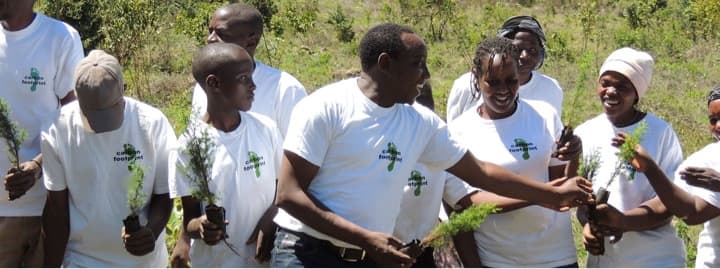
The background to our reforestation project on the Kikuyu escarpment in Kenya's Great Rift Valley, with yearly updates from project leader Mburu Waiganjo and the team. For current prices, species and this year's planting, see our Kenya tree planting page.
Background
The challenge on the Kikuyu escarpment
Why this forest matters to the communities that live alongside it.
The Kikuyu escarpment forest, with its great mixture of both large and small wildlife animals, birds and butterflies, has been the beautiful gateway to the Great Rift Valley until the degradation trend struck. This environment is the source of water, and thus livelihood, to the neighbouring communities.
In just a few years, wanton and deliberate destruction of the escarpment environment through charcoal burning, logging for timber and fuel wood, ring-debarking of medicinal trees and overgrazing has resulted in the virtual depletion of forest vegetation cover. This has in turn resulted in the drying of springs, rivers and streams, soil erosion, emigration of wildlife and birds, scorching sun, human-wildlife conflict and the scarring of a once beautiful scenic landscape that generated some income through tourism.
The worst result of this environmental destruction was the ethnic clashes witnessed between the pastoral Maasai and the farming Kikuyu over use of the dwindling water resources at the base of the escarpment. This resulted in unnecessary deaths, injuries, loss and destruction of property and the displacement of many families.
The communities have, due to the negative climatic changes, become even more dependent on the forest for their livelihoods. The women and girls move longer distances in search of fuel wood and water, exposing them to the danger of attacks and sexual assaults. The Maasai have to bring their cattle to graze in the forest. With the loss of flora and fauna, the tourism income has dwindled, bringing the curio business down with it.
This project aims to plant hundreds of thousands of indigenous trees on the worst degraded areas.
Additional social and sustainability benefits
Poverty reduction through employment creation
Water catchment areas will be conserved, providing water and food security
Birds, butterflies and other wildlife habitats will be conserved and others created
Bees attracted by the trees in flowering seasons will benefit the community through the sale of honey, hence reducing poverty
Sale of fruit will help the community earn extra income
Ecotourism will be promoted, with better forests giving an alternative occupation to those previously engaging in destructive forest activities
The pastoral communities will have pastures for their animals during drought times
Some of our teams include orphans and Persons Living With HIV/AIDS (PLWHA)
The trees also assist in the prevention and control of soil erosion
Beautification of our locality and the roads
UN Sustainable Development Goals supported
Project Updates
Kenya project updates 2018 to 2024
Reports, photos and videos from the team on the ground, newest first. The latest updates are on our Kenya tree planting page.
2024 trees update
Take a walk with project leader Mburu Waiganjo, who shows you the amazing progress made this year.
2023 trees update
Project leader Mburu Waiganjo summarises all the actions in words and pictures. Over 100,000 trees planted this year.
2022 trees update
The Kenya project highlights the importance of having a great coverage of vegetation in the forests. Without it, the springs and rivers dry up, soil erodes and wildlife emigrates, which can lead to human-wildlife conflict. This can lead people to be displaced and homeless; also, animal species can become sparsely populated, which can drive them to endangerment as the likelihood of reuniting the population is slim.
The Kikuyu escarpment forest has an array of different species, from birds to butterflies. The environment is also a key source of water for the surrounding community, which is why protecting it is so important. Due to logging for timber and fuel, overgrazing and charcoal burning, the forest has become wounded and depleted.
The forest ensures that the climate and rainfall are suitable and a consistent harvest is met for the people of Kenya. Considering the restoration is near community farms, it is highly important that the community regains the micro-climate that provided them with a great harvest. The new plantings will close the sparse parts of the forest, which should ensure a micro-climate is built for the community around the forest. The goal for the rest of the rain season is to plant an additional 45,000 trees, which will benefit the agriculture in the neighbouring farms and the climate.
Sustainable production and consumption of food will be enhanced by the tree planting project. Trees can provide a micro-climate suitable for growing different types of vegetables; in warm weather, trees create a cooler, damper micro-climate which allows the crops to stay shaded and avoid too much sunlight. Additionally, trees need water to survive, which means their roots will have access to water. For the other plants this is beneficial, as there will be more water accessible for them. This can help agriculture, as lots of highly nutritious vegetables are tedious to grow and can be damaged by intense heat or light.
2022 planting update - International Day of Forests
Our project is now one of the most respected forest restoration programmes in Kenya, and this is evident from the fact that we have for the second time been chosen as the hosts for the commemoration of the International Day of Forests tree planting. For the International Day of Forests 2022 we planted 2,000 trees to rehabilitate and restore a highly degraded section at the edge next to the community farms. This section requires about 20,000 trees to return to a healthy status. 20,000 holes are ready for tree planting when we get the rains. The forest-adjacent community is eager to have this section of the forest restored, as they have lost the micro-climate that previously enabled them to produce peas and spinach in large quantities much earlier than the rest of the farms away from the forest.
We also have two other planting sites where holes are ready for planting on a wetter area. These areas will close the gaps at the edges of the site of successfully rehabilitated forests. We had left these areas as they were prone to grazing, but now that the Kenya Forest Service has declared them grazing-free zones, we can fill them up with trees. With COVID-19 cases drastically reduced and restrictions relaxed, we have more team members engaging in our forest work and the pace of forest restoration will be much faster. The tree planting work has helped to support our teams and helped them stay strong over these challenging times. Since Christmas 2021, we have planted 15,500 trees and plan to plant another 45,000 trees in all during this long rain season. We look forward to a busy season of tree planting and to updating you soon.
Mburu Waiganjo, Project Leader
2021 planting update
New ways of working keep the project on track
Read project leader Mburu Waiganjo's report for 2021.
The year 2021, just like 2020, has been ravaged by the COVID-19 pandemic with the accompanying curfews, lockdowns and movement restrictions which affected our normal way of working.
In mid-February, we had embarked on tree planting to replace the withered trees, but it was short-lived as we were back into restrictions and lockdowns.
After the lockdowns, we had to adjust to having more days to transport the trees to the forest rather than on the planting day, using more vehicles to transport and allocating portions for individuals to plant, but eventually planting the normal way as a team while exercising physical distance.
We planted during the long rains season and also during the national tree planting launch that we were privileged to host; in total 6,000 trees were planted. The team continued with planting an additional 8,000 trees during the week after the launch.
The project continues to provide work and income to the team members and in many cases their relatives, who have now come to live with them.
Besides, the Government of Kenya has appreciated that we are one of the most sustainable and long-lived community-based organisations working in the forest sector and thanked us for our immense contribution to forest restoration and conservation. They have promised to send some groups to us for benchmarking and information sharing, which we shall readily offer.
Though most of us in the group have been indirectly affected by the wrath of the COVID-19 pandemic, we all agree that it could have been worse were it not for our reforestation project.
Over the next 3 months we hope to be planting another 30,000 to finish a challenging year.
2020 planting update
Despite the challenges our young forest grows with burgeoning biodiversity
Read project leader Mburu Waiganjo's report for 2020 and watch the video from the site.
The year started very well with lots of rain continuing from 2019 all throughout January and early February. We therefore continued catering for the trees planted in the previous year with spot weeding and elimination of some parasitic climber vines that can choke the trees.
Unfortunately, as we got to March, the global COVID-19 pandemic caught up with us and we had to stop all activities and obey the government's "stay at home" orders. We already had 10,000 trees ready for planting and the holes were also ready.
Fortunately, in May, we were allowed to go back to the forest, albeit following strict protocols of having soap and water for hand washing, maintaining physical distance and wearing a face mask, and we quickly continued with forest work. We planted the 10,000 trees, which we continue spot-weeding.
We are ready with another 10,000 trees soon to be planted once the ground is adequately prepared. During the lull in planting many of our prepared holes got waterlogged, so we need to prepare again.
COVID-19 pandemic and hardship
The financial resources from the project, coupled with team members having sources of income from the dairy cows, traditional chicken eggs and the small businesses that they have since established, completely cushioned us from these very tough COVID-19 times. Some of the relatives who moved upcountry when the city closed and were unfortunately caught up with the cessation of movement orders had to be hosted by our team members; they even wanted to participate in tree planting, but the limitation on the numbers participating could not allow it.
Team member Joyce Gachoki says: "I have never hosted a person for a week - let alone an entire family of four for over a month - but since we had some advance payment and also continued working later during the lockdown, while the visiting family also assisted in feeding the dairy cows and chicken on my small garden, I managed without much hassle, but all this because of the income I get from working for the reforestation project. We were also lucky as we sold avocados, which were plentiful this season."
The stories are the same for all team members who have managed to weather the pandemic - they were able to feed the children well; they seem to eat more while at home though.
Team member Njehia's tree nursery has grown and he is now selling more grafted Hass avocado tree seedlings. He also provided most of the trees we planted in May.
Thanks to the reforestation project, we have gained the necessary financial resilience that came in handy during the very tough coronavirus pandemic; we couldn't appreciate it more.
Growing biodiversity and looking forward
We continue with our partnership with community members who have perched beehives within our forest. What is amazing is that - despite the global cry of declining bee numbers - the beekeepers seem not to suffer such a fate; there are plenty of bees and they are harvesting their honey and readily able to sell it, generating much needed income.
We believe that, besides getting their nectar from the forest, they must also be getting it from the forest-adjacent farms, thus also helping with pollination of crops and fruits and hence offering an essential ecosystem service of supporting food production.
The forest has really grown to become thick and beautiful. The sound of birds is nice music to those who venture near the forest, especially during the COVID-19 lockdown when people got bored and found solace in the healthy forest environment. We are getting requests to develop nature trails within the forest for people who want to venture inside and we shall plan with Kenya Forest Service (KFS) for this purpose.
2019 planting update
Project leader Mburu Waiganjo's report for 2019.
We now have over 180,000 trees planted since we started. The trees have survived extraordinarily well and nowadays the KFS is bringing other community-based organisations interested in tree planting for benchmarking tours.
The community recognises the changes to the livelihood of some of our team members who were previously dependent on selling forest-collected firewood for survival, but who are now sustainably and gainfully occupied as forest defenders, enjoying the better social status of a regular job and income, including being dairy cow owners, which is prestigious. Some of the welfare and empowerment initiatives, like indigenous chicken rearing, zero-grazing cows and planting of avocado fruits, are now bearing fruit with alternative incomes for our members. All our members are comfortably bringing up their children, most of whom are in school and in colleges. There are those whose children are in employment after attending college.
During a party to celebrate 10 years of the tree planting, members reflected on the desperate life that they lived before, especially the women who had to walk for kilometres in the forest, dodging forest guards and dangerous obstacles to collect firewood and go and sell it at the shopping centres for very little money.
Besides the community tree nurseries that produced 10,000, two of our members have produced 10,000 tree seedlings and sold over 5,000 to other members of the community who are embracing tree planting. The next big opportunity for them is to produce grafted Hass avocado tree seedlings, which are in huge demand and are lacking.
The community really appreciates the drastic changes that our planting has made in the fast restoration of the formerly hugely degraded forest to the thick, healthy, species-rich forest we now have.
We now have an abundance of bird species, chameleons and many butterfly species, dik-diks, antelopes, red forest duikers, hares and elands; biodiversity on the project site has improved tremendously.
We appreciate and are proud of playing a role in the growing positive attitude towards tree planting in our country and globally. Today every group, including men, women, youth, church and other organisations, is competing for an opportunity to plant trees in their lands or public places.
Project leader Mburu Waiganjo told us: "What makes me personally proud is the fact that our project has reversed a forest degradation trend, and the 'don't care' attitude towards forest conservation that had prevailed has now gone and yielded the current lush green forest that is teeming with wildlife noises from the birds, the beauty of the butterflies and other insects which are evidently useful in pollination of crops in the forest-adjacent farms. The community's possession and ownership of the forest as their communal resource and source of livelihood, and their enthusiastic participation in the project, is also a unique progress that accompanies the project's growth."
We have planted over 150,000 trees in Kenya's Great Rift Valley over the past 10 years.
Over 20 different species of native broad-leaf trees - including Olea africana, Cordia africana, Ehretia cymosa
Significant community benefits - providing education, new skills and employment
Water regulation provided via groundwater recharge
Soil erosion and landslides averted
Encouraging biodiversity on the planted sites - antelope, red forest duiker, eland, dik-diks, many bird species, chameleons and many butterfly species
This season, 2 nurseries established within the community will be providing 6,000 of the 20,000 trees already scheduled for planting. In a neighbouring community, further trees are being grown for planting by a women's group and farmer field school.
Carbon Footprint Ltd's reforestation work in the Great Rift Valley was endorsed by the United Nations Environment Programme (UNEP), and trees pledged and planted by Carbon Footprint and ESCONET were included in UNEP's Plant for the Planet: Billion Tree Campaign.
"We have but a short time to avert damaging and economically debilitating climate change. Forests are natural and economically important 'carbon sinks'. Globally, forest cover is at least one-third less than what it once was. It is time to reverse the trends, it is time to act."
Achim Steiner, then Executive Director, UN Environment Programme
The community planting team, Great Rift Valley
Support the Kenya project today
Plant trees from £3 + VAT, or choose Tree Buddying at £9.50 + VAT to pair every tree with a verified VCS tonne.